
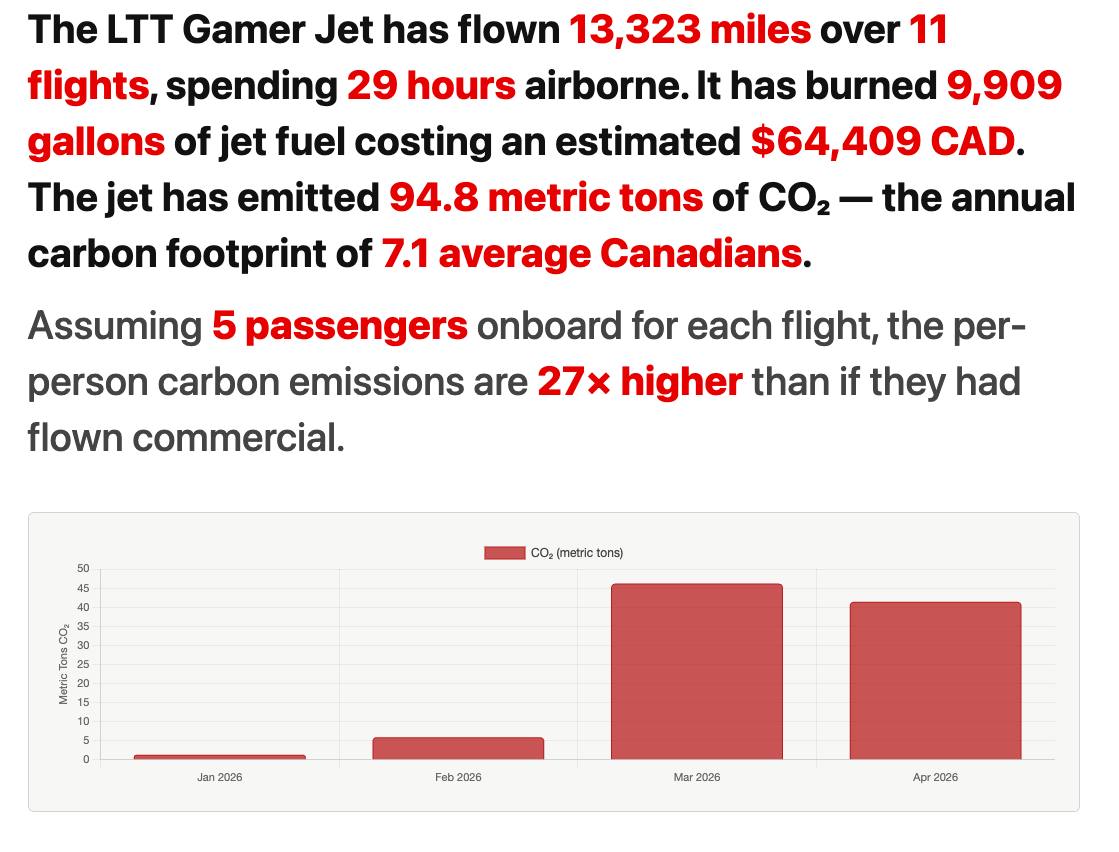
Recently the tech YouTuber Linus Sebastian (Linus Tech Tips) bought a private jet and naturally this has unleashed a torrent of hot takes from fans and haters alike.
The arguments mostly boil down to whether or not the emissions and subsequent impact on the environment are unreasonable or justifiable. Of course, the arguments are pretty thinly sourced so I figured I could do some napkin math to suss out what the impacts actually where. Here’s what I came up with…
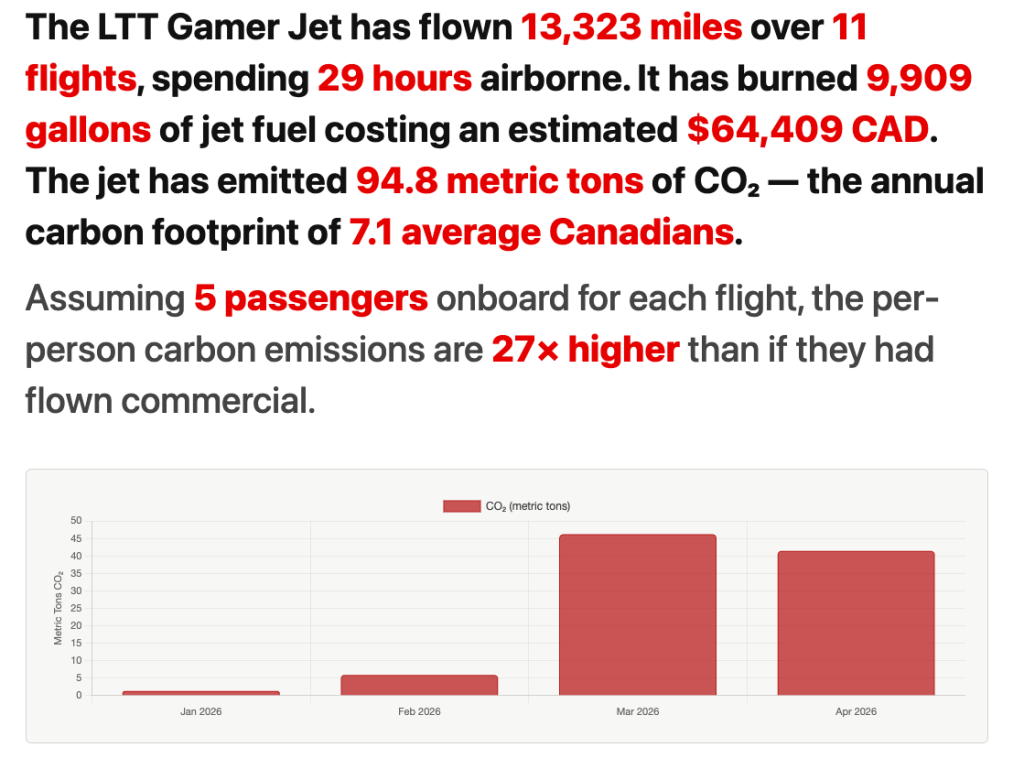
Some notes on the methodology:
Fuel Consumption
The Falcon 900B is powered by three Honeywell TFE731-5BR turbofan engines. A mission-average burn rate of 347 US gallons per hour is used for ICAO type F900, sourced from Jack Sweeney’s plane-notify aircraft fuel consumption dataset. This figure accounts for high fuel burn during climb and descent.
CO₂ Emissions
Jet A fuel releases 9.57 kg of CO₂ per US gallon burned, the ICAO-standard factor for direct combustion emissions. These are direct emissions only. Aviation’s full climate warming impact is estimated at 2–4× higher when accounting for contrail formation, NOx, and other high-altitude radiative effects (Lee et al., 2021).
Distance
Flight distances are measured from the actual GPS track recorded in ADS-B Exchange KML files, computed as the sum of haversine great-circle distances between each successive position fix. This reflects the actual flown path, not a straight-line estimate.
Fuel Cost
Jet A fuel is estimated at $6.50 CAD per US gallon, an approximate Canadian market average. Actual prices vary quite a bit by airport, supplier, and volume. This figure does not include operating costs like crew, maintenance, landing fees, and other expenses.
Commercial Flight Comparison
Per-passenger commercial CO₂ is estimated at 0.0322 kg per km, derived from the ICAO Carbon Emissions Calculator.
ADS-B Data Sources
Historical flight tracks were sourced from ADS-B Exchange KML exports.